
Introduction
The vestibular system is most generally associated with the vestibular organs located in the inner ear, namely the semicircular canals and the otoliths. With the semicircular canals sensing rotational head movement and the otoliths sensing linear vertical and horizontal motion, both organs provide the brain with important information for essential functions like balance and spatial orientation.1 However, vestibular information is processed across multiple levels within the brain, including an extensive network in the cortex.2–5
While cortical integration of vestibular information is still poorly understood, it has gained some additional interest in recent years, partly due to potential interactions between such information and higher-order brain functions.6–8 More specifically, recent findings point to the possibility that vestibular information might not only modulate functions in the realm of perception, but also cognition and behaviour more generally.6,9–18 Many of these findings emerged using a non-invasive, vestibular stimulation technique called galvanic vestibular stimulation (GVS), which modulates the firing rate of the vestibular nerve by applying a low-intensity electrical current through an anode and a cathode placed on the mastoids.10,18–23
Interestingly, several studies investigating these modulations found them to be dependent on the position of the anode and cathode, i.e. the polarity of the stimulation.10,19,20,22,24,25 For example, De Maio et al19 administered GVS with different polarity configurations while participants performed the Balloon Analogue Risk Task (BART).26 They found that the propensity to take risks was reduced in the left-anodal/right-cathodal stimulation condition (L-GVS) compared to a configuration with inverted polarity, i.e. in the right-anodal/left-cathodal stimulation condition (R-GVS). In line with previous studies, De Maio et al19 suggest that such polarity-specific effects might result from lateralized activation patterns and hemispheric dominance.10,20,22 More specifically, L-GVS seems to mainly activate the right cerebral hemisphere, while R-GVS leads to a more balanced activation between the two hemispheres.27 Polarity-specific effects might consequently emerge by modulating the activity of specific brain areas associated with certain behavioural tasks. In the case of the BART, polarity-specific vestibular information might influence risk-taking by specifically modulating the activity of the right anterior cingulate cortex and insula, which are involved in risky decisions during this task.19,28
However, despite the empirical evidence advocating for polarity-specific vestibular effects, the proposed neural mechanisms pose some questions. Most notably, polarity-specific vestibular effects are hard to reconcile with the current understanding of how GVS is processed by the brain. Research strongly indicates that vestibular information from the two peripheral vestibular end-organs is combined in a push-pull-like fashion at the level of the vestibular nuclei before ascending to the cortex.21 In this context, vestibular information entering the cortex is unlikely to differ between L-GVS and R-GVS, because polarity-specific information might already be lost at the level of the vestibular nuclei.
Additionally, vestibular and cognitive functions are assumed to be interconnected in this model, but the extent of the neuroanatomical and functional overlap between the two is still a matter of debate.6 For example, while risk-taking is generally associated with the anterior insula, vestibular processing is generally much more associated with the posterior insula29,30 or the parietal opercular (OP2) region.5,29 It remains unclear if and how these two functions interact. This potential interaction is also complicated by the fact that GVS does not exclusively act on the vestibular nerve, but is known to have confounding effects such as the activation of autonomic brain areas, which in turn can modulate cognition and behaviour.6,31
In this current preregistered study, we attempted to replicate and extend the findings by De Maio et al19 following the three aims below: Firstly, we attempted to replicate the findings of the study by using a highly similar experimental procedure and task, but relying on a bigger sample size based on an a priori power analysis and a balanced within-subjects design.
Secondly, we also attempted to gain further information about the nature of the polarity-specific vestibular effect by using an additional set of statistical tools. More specifically, we used equivalence testing to obtain information on the true effect size.32 Using such a procedure seems important not only because the originally specified effect size seems rather large (d = 0.548), but also because little is known about the true effect size of such effects in general.
Lastly, we aimed to extend the findings of the original study by probing the effect in the context of another risk-taking task, namely the Game of Dice Task.33 While the BART is one of the most popular implicit risk-taking tasks, it suffers from inherent methodological issues.34 Most importantly, the BART is unable to clearly differentiate between uncertainty and risk. As outlined by De Groot and Thurik,35 the BART measures uncertainty at the beginning of the task (i.e. deciding under unknown outcome probabilities), while slowly shifting to measuring risk as participants implicitly learn about the underlying probability distribution (i.e. deciding under known outcome probabilities). Consequently, the BART measures two distinct decision-making processes, which are also associated with distinct forms of mental and neuronal processing.34,36,37
While the GDT matches the BART in terms of simplicity and shortness, it is based on explicit outcome probabilities, thus clearly measuring risk rather than uncertainty. Using the more explicit GDT to assess risk-taking will yield additional information on which domains of the constructs are affected by vestibular information. These findings might also inform or challenge the vestibular processing model proposed by De Maio et al19 and others.
As outlined in our preregistration, this replication study would be deemed successful if we succeeded in replicating the polarity-specific vestibular effect found by the original study. Additionally, the equivalence test had to yield a non-significant result to deem the replication successful. Importantly, since the BART and GDT possibly do not measure identical aspects of risk-taking on a behavioural and neural level, we refrained from making the success of this replication dependent on the GDT findings. Since this is also the first study investigating the influence of GVS on risk-taking in the GDT, we refrained from postulating an a priori hypothesis for the GDT results.
Methods
Preregistration
This study was preregistered on the Open Science Framework using the replication recipe proposed by Brandt et al.38 The complete preregistration can be found here: https://osf.io/ufy7j.
Participants
A sample of 37 university students was recruited for this study (29 women, 8 men, mean age = 22.4, SD = 2.1), aiming to mirror the sample demographics of the original study (19 women, 1 man, mean age = 19, SD = 1.28). The sample size was based on an a priori power analysis, with the goal of achieving 90% power. The power analysis was based on the effect size reported in the original study (d = 0.548), relying on = 0.05. The analysis was conducted using G*Power (Version 3.1.9.7).39 Left-handed participants as well as participants with neurological, psychiatric, vestibular, or auditory disorders were excluded from participating. Handedness was assessed using the Edinburgh Handedness Inventory.40
This study was approved by the Ethics Commission of the Human Sciences Faculty of the University of Bern (Approval number: 2023-10-00006) and was performed in accordance with the current version of the Declaration of Helsinki.41
Experimental Procedure
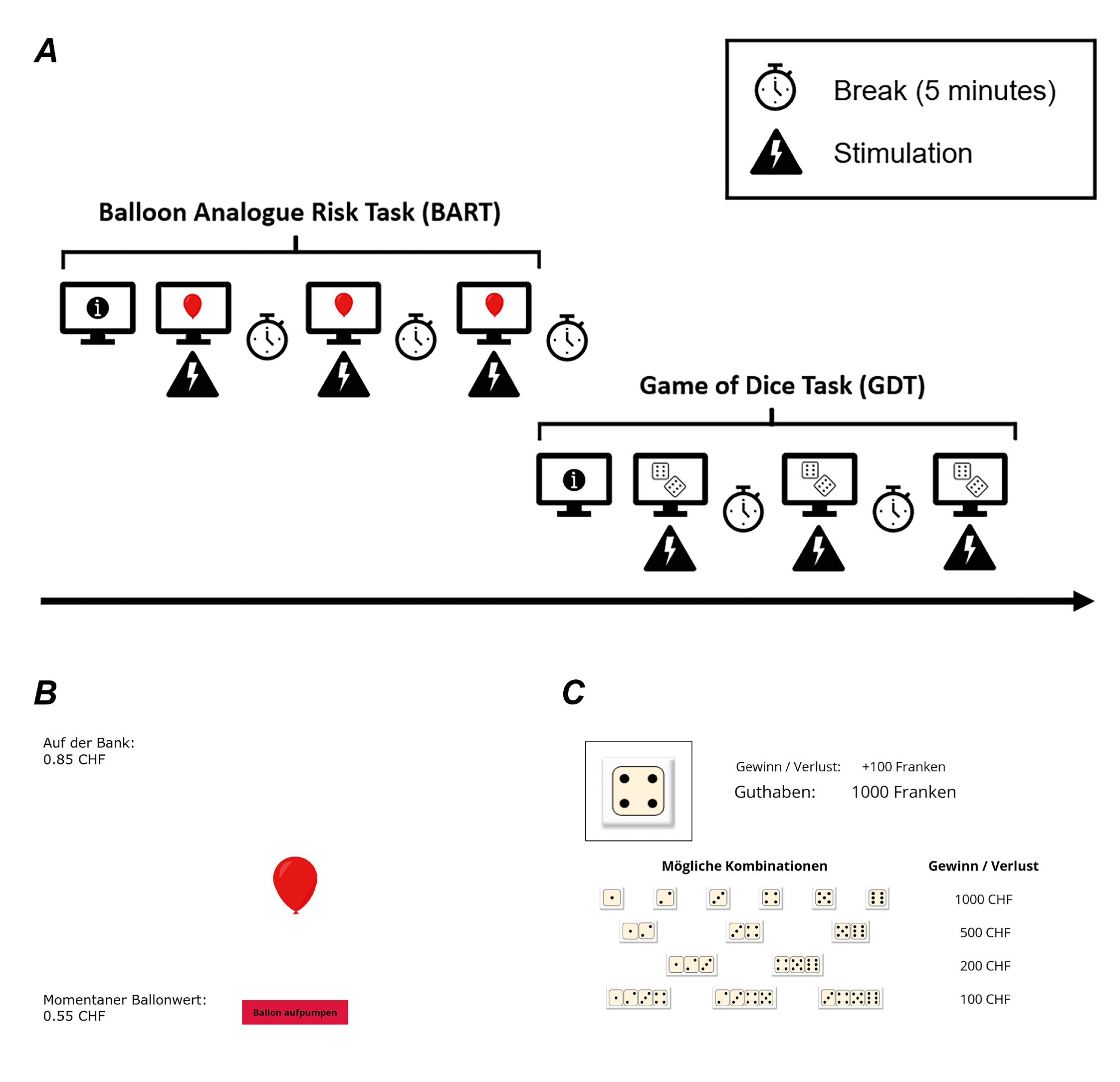
Participants received general study information and signed an informed consent form before the GVS electrodes were attached to the participants’ mastoid processes and necks. Each participant then performed 6 experimental blocks on a computer (27" screen, 2560 x 1440 resolution, 144 Hz refresh rate; Brentford VR Midi Gamer PC, 16 GB RAM, 64-bit operating system). The BART was presented in blocks 1–3, closely reproducing the experimental procedure outlined in the original study. Subsequently, the additional GDT was presented in blocks 4–6, using the same procedure (Fig. 1A). During each experimental block, one of three possible stimulation configurations (L-GVS, R-GVS, SHAM) was applied in a predetermined order. More specifically, we partially counterbalanced the stimulation conditions across participants to ensure an optimally balanced within-subjects design. As in the original study, a timed break of 5 minutes was implemented between the experimental blocks to avoid possible carryover effects of the stimulation in the subsequent experimental block. During these breaks, participants were asked to sit quietly on the chair. The participants performed all tasks while sitting on a chair with their chin resting on a chinrest, keeping them at a distance of 55 cm from the computer screen. During the experimental blocks, participants were wearing headphones (SONY WH-1000XM4). In line with the study conducted by De Maio et al,19 the participants were instructed to earn as much money as possible throughout the experiment, but they were also informed at the beginning of the study (via the general study information) that these earnings would not be paid out.
Balloon Analogue Risk Task (BART)
Before starting the task, participants received written and oral instructions. The task was designed to closely match that of the original study. It consisted of red balloons, which were presented in the middle of the screen (Fig. 1B). The participants then had the chance to pump the balloon up by clicking a button below the balloon with the left mouse button using their right index finger. For each pump, the participants received 0.05 Swiss francs (0.05 CHF 0.05 US dollars) while inflating the balloon. This temporarily gathered money was displayed in the bottom-left of the screen. The participants could then continue to inflate the balloon until the balloon exploded, in which case they would lose all the temporarily gathered money. Alternatively, they could decide to collect the temporarily gathered money by clicking the right mouse button with their right middle finger. In this case, the money was saved in a bank displayed on the top-left of the screen until the end of the experimental block. Depending on the outcome, the sentence “Ups! Der Ballon ist explodiert!” (“Oops! Lost that one!”) or “Sie haben … CHF auf die Bank übertragen” (“You have banked … CHF”) was displayed in the middle of the screen for 1.5 seconds before a new balloon was presented. During each experimental block, 30 balloons were presented.
As in the original study, each balloon was associated with a specific breaking point and the order of presentation was randomized within each experimental block. The probability distribution of the balloon breaking points was taken from the original study, ranging from 1 to 128.19 Before the 3 experimental BART blocks started, a practice block consisting of 5 balloons was presented to the participants in a randomized order. The task was programmed and presented using PsychoPy3 (Version 2023.2.2).42
Game of Dice Task (GDT)
Participants received written and oral instructions for the GDT right after finishing the last BART block. Each GDT block consisted of 18 dice throws (i.e. trials) and each participant started with a balance of +1000 francs 1000 US dollars). In each trial, the participants chose one out of 14 dice combinations by clicking the combination with the left mouse button. Each combination consisted of a set of 1 to 4 dice numbers, which were identical to the ones used by Brand et al.33 The numbers did not change throughout the task (Fig. 1C). They could then throw a separate die using the right mouse button. If the number indicated by the thrown die was included in the selected combination of dice numbers, the participants received a reward. Conversely, if the number was not included, participants lost the same amount of money. The gained or lost money per trial was dependent on the chosen dice combination: Choosing a set of 4-number combinations was associated with a gain or loss of 100 francs, a set of 3 combinations with 200 francs, a set of 2 combinations with 500 francs, and a set of one die number with 1000 francs. As in the BART, the next trial was presented after 1.5 seconds.
The numbers indicated by the thrown dice ranged from 1–6, with each number appearing three times during one experimental block. The order of the numbers was randomized within each experimental block. As in the BART, a practice block of 5 trials was presented to the participants before the actual task. The task was programmed and presented using PsychoPy3 (Version 2023.2.2).42
_illustration_of_the_task_design._the_bart_is_presented_.png)
Galvanic Vestibular Stimulation
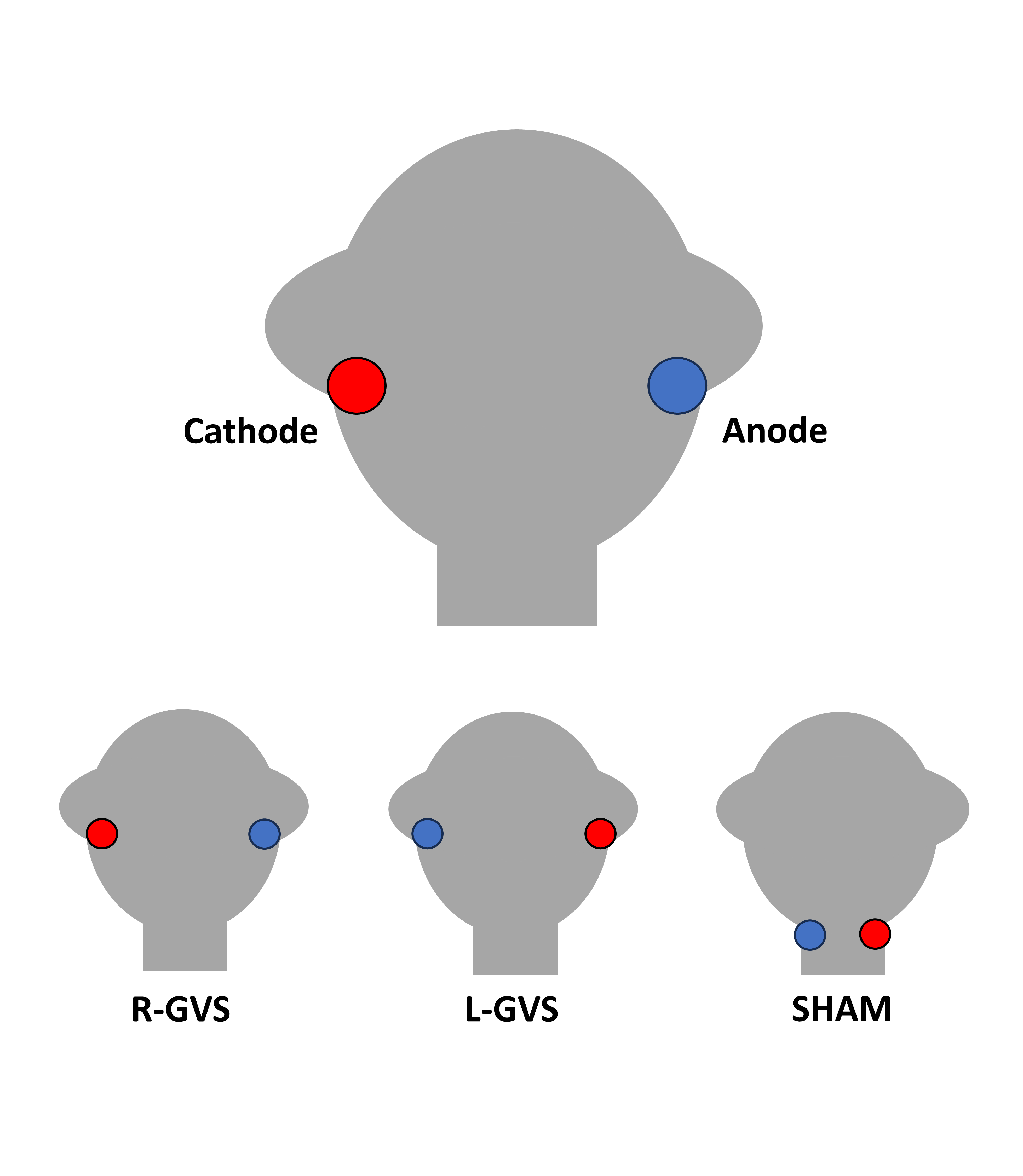
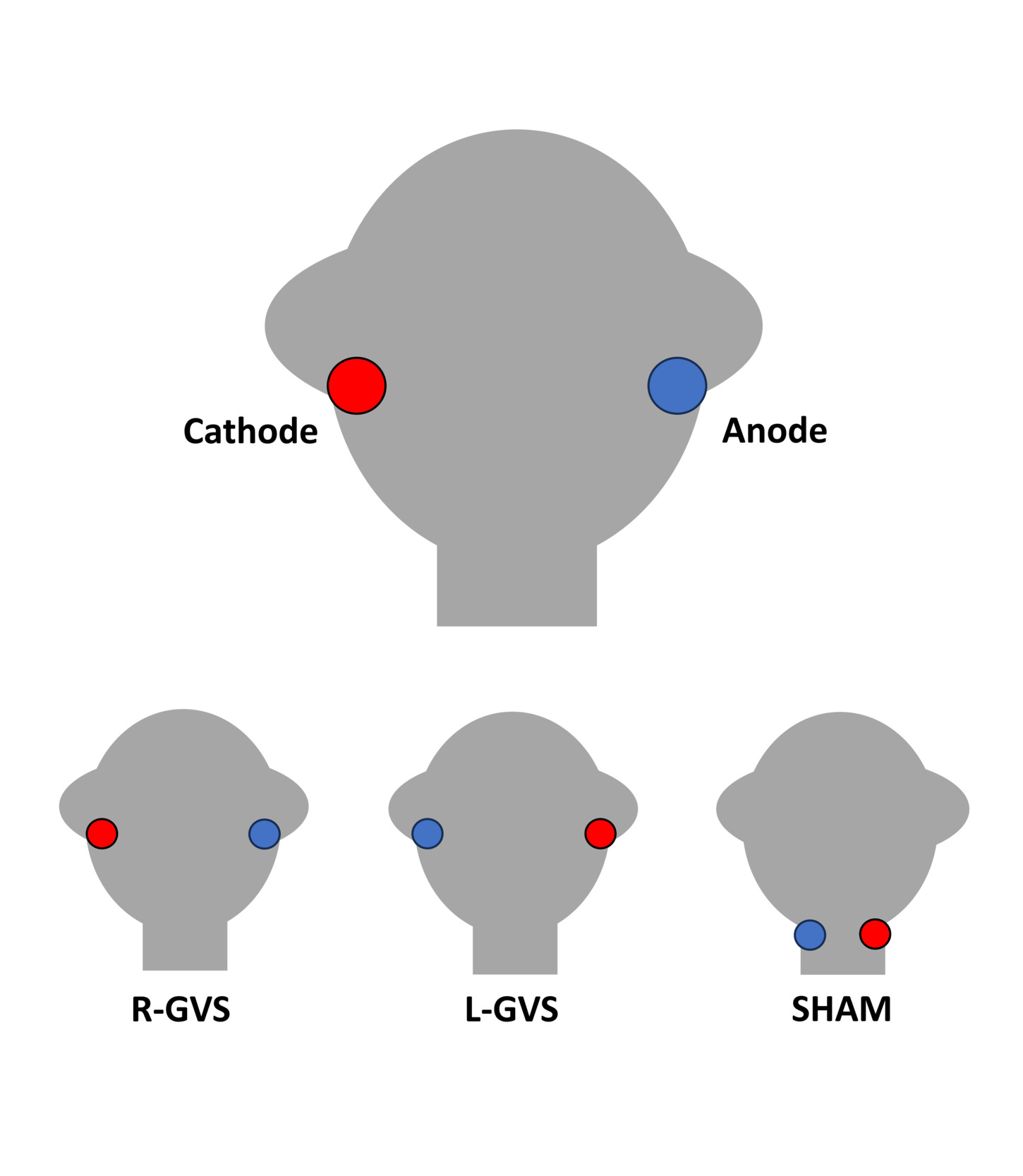
GVS was administered using a stimulator (NeuroConn DC-Stimulator Plus, neurocare group AG, Ilmenau, Germany). In line with the study conducted by De Maio et al,19 a current with an intensity of 1 mA was delivered in a square waveform. While stimulation fade-in and fade-out were not mentioned in the original study, they were implemented in this study (initial 5 seconds fade-in, 8 seconds fade-out) to improve the comfort level and blinding for the different stimulation conditions. Otherwise, the stimulation protocol fully matched the one used in the original study. Two rubber electrodes were attached to the mastoids to apply polarity-specific GVS. As in the original study, the left-anodal and right-cathodal configuration was defined as L-GVS, while the right-anodal and left-cathodal configuration was named R-GVS. Likewise, two additional electrodes for the SHAM stimulation were attached to the neck, placed 5 cm away from the GVS electrodes (Fig. 2). The purpose of this SHAM stimulation was to induce comparable skin sensations, while simultaneously controlling for unspecific arousal effects not associated with stimulating the vestibular system.19 All electrodes were attached using medical tape. Electrolyte gel was used to reduce the impedance between the skin and the electrodes. The electrodes were left in place for the whole experiment, and the different stimulation conditions were realized by replugging the electrode cables into the stimulator. The stimulation device was positioned behind the participants and all cables were unplugged after each stimulation block to prevent participants from noticing the changing plugging patterns. The stimulation was started at the beginning of each experimental block. Participants were allowed to begin the task after the stimulation fade-in (i.e. after 5 seconds) and the stimulation continued until the participants finished all trials of one experimental block.
Data Analysis
All data analyses were performed using R (Version 4.3.2)43 and RStudio (Version 2023.06.2).44 An was used for all statistical inferences. As outlined in the replication success criteria in our preregistration and the present study, we were primarily interested in the polarity-specific effect in the BART, making it the only relevant confirmatory analysis. Thus, with the exception of the repeated-measures ANOVA described below, we refrained from correcting for multiple testing.
Balloon Analogue Risk Task (BART)
As outlined in the preregistration, the data analysis protocol closely followed the original study. The adjusted mean pumps, i.e. the average number of pumps for all unexploded balloons, was calculated for each participant to assess risk-taking in each experimental block.26 This score was then used to test for a generic and polarity-specific stimulation effect. More specifically, to test if vestibular activation in general affects risk-taking, the average of the adjusted mean pumps in the L-GVS and R-GVS conditions (i.e. (L-GVS + R-GVS) / 2) was compared with the adjusted mean pumps in the SHAM condition. For the polarity-specific vestibular effect, the adjusted mean pumps in the L-GVS and R-GVS condition were compared. A two-sided paired t-test was used to test the significance of both effects.
Trials in which the money was collected after 0 or 1 pumps, were excluded. This is reasonable because one can assume that they either were given unintentionally or indicated non-adherence to the task instructions (i.e. earning as much money as possible). Consequently, participants who collected the money after 0 or 1 balloon pumps in over 10% of the trials in one of the three experimental blocks were excluded from the analysis. Additionally, only data from participants who performed all three BART blocks and all three GDT blocks entered the analysis. This criterion was applied to ensure complete data, while also excluding participants who had to terminate the experiment preemptively due to severe stimulation side-effects. Side-effects were monitored by asking the participants at the beginning of the experiment to report any unpleasant sensations to the experimenter.
On the basis of these criteria, 0.24% of all trials were excluded. However, no participant had to be excluded from the analysis based on the exclusion criteria mentioned above. Also, while some participants reported tingling sensations, none of them reported severe side-effects like pain, headaches, vertigo, or nausea.
Additionally, an equivalence test using the two one-sided tests (TOST) procedure was performed.45 Equivalence tests allow for rejecting the hypothesis that the effect size is as large or larger than the smallest effect size of interest (SESOI).45 Thus, a significant test either implies that there is no meaningful effect at all or that the true effect size must be at least significantly smaller than the specified SESOI. Since only little information about the possible true effect size was available in this case, the minimal detectable effect size of the original study was used as a SESOI (d = 0.48).45 While this will not allow for the conclusion that there is no meaningful effect at all, it supports inferences about the true effect size. More specifically, a significant test would imply that the true effect could not have been detected by the original study, since the observed effect size is significantly smaller than the minimal detectable effect size.
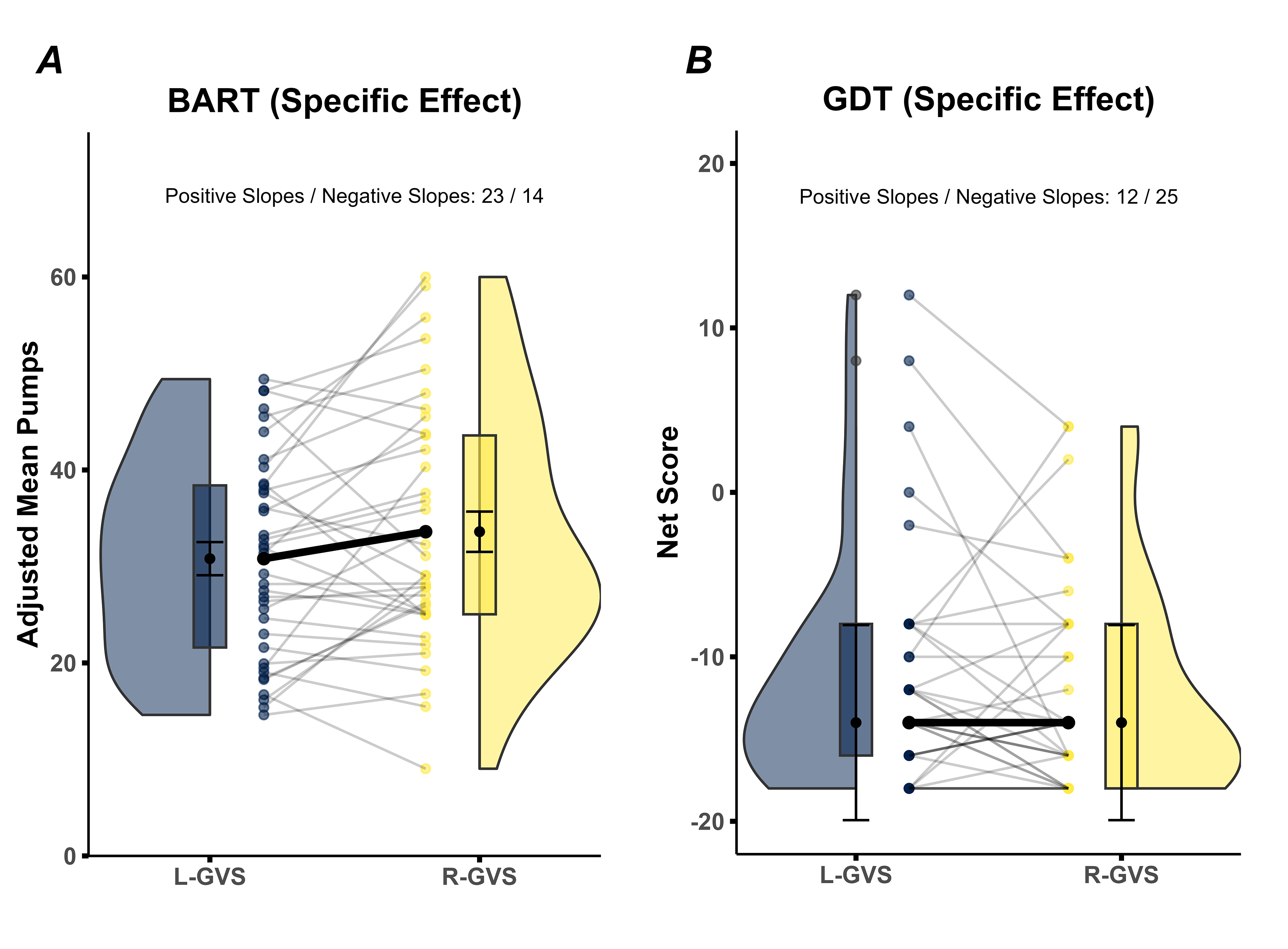
We would like to emphasize that we also performed some additional exploratory analyses, which were not part of our preregistration. Firstly, the non-parametric equivalent of the paired t-test (i.e. a two-sided Wilcoxon test for matched samples) was used to investigate the difference in adjusted mean pumps between the L-GVS and R-GVS condition. Corroborating the results with a non-parametric test seemed necessary, because the R-GVS data indicated negative skewness and thus might violate the assumption of normality (Fig. 3A).
Secondly, because the BART is prone to learning effects,34 we also evaluated the temporal dynamics of the adjusted mean pumps in our study. A 1x3 repeated-measures ANOVA with a Greenhouse–Geisser correction was performed with the factor “block” (i.e. experimental block 1–3) as the within-factor. The main effect was further explored by conducting paired t-tests between the three blocks, adjusting for multiple testing using the Bonferroni-Holm correction. Additionally, an unpaired two-sided t-test between the L-GVS and R-GVS condition using only the data from the first experimental block was performed. Focusing on the difference in adjusted mean pumps between the two groups in the first experimental block allows for a more confident elimination of potential learning effects.
Thirdly, Spearman’s correlation coefficient between the adjusted mean pumps of the BART and the net score of the GDT was calculated to investigate the relationship between the two risk-taking tasks in this current study.
Game of Dice Task (GDT)
We assessed risk-taking in the GDT by calculating a net score used in other studies.46,47 More specifically, we subtracted the safer choices (i.e. choosing a combination with 3 to 4 dice) from the risky choices (i.e. choosing a combination with 1 to 2 dice). Consequently, a negative net score indicates a lower risk-taking tendency, while a positive score indicates a higher propensity. Analogous to the BART data analysis, we then used the net score to test for a generic and a polarity-specific vestibular effect. Due to the expected non-normality of the GDT net score distribution, the general vestibular activation was defined as the average of the median net scores of the L-GVS and R-GVS conditions (Median L-GVS + Median R-GVS / 2). The adjusted mean pumps resulting from the general vestibular activation were then again compared with the adjusted mean pumps in the SHAM condition. The polarity-specific vestibular effect was defined as the difference between the median net score of the L-GVS and R-GVS condition. A two-sided non-parametric Wilcoxon test for matched samples was used to test for significance.
Results
Balloon Analogue Risk Task (BART)
Preregistered Analysis
The number of adjusted mean pumps was lower in the L-GVS condition compared to the R-GVS or the SHAM condition on a descriptive level (Table 1). Additionally, the proportion of exploded balloons was similar across all conditions (Table 2).
The t-tests for both the generic vestibular effect( = -1.02, p = 0.315, d = -0.17, 95% CI [-0.50, 0.16]) and the polarity-specific vestibular effect ( = -1.95, p = 0.059, d = -0.32, 95% CI [-0.66, 0.01]) were not significant (Fig. 3A). The equivalence test based on the TOST procedure yielded a significant result ( = 2.05, p = 0.024).
Exploratory Analysis
Using the median as a measure of central tendency, the number of adjusted mean pumps was higher in the L-GVS condition (Mdn = 31.38, MAD = 12.42) than in the R-GVS condition (Mdn = 29.09, MAD = 11.44). The non-parametric Wilcoxon test for these two conditions did not reach significance (V = 232, p = 0.072, r = 0.296).
The repeated-measures ANOVA conducted to investigate the temporal course of the average adjusted mean pumps across the experimental blocks yielded a significant main effect of the factor “block” ( = 18.88, p 0.001, = 0.764). The post-hoc comparisons indicated significant differences between block 1 and 2 ( = -4.259, p 0.001), block 1 and 3 ( = -4.892, p 0.001), and block 2 and 3 ( = -2.470, p = 0.018). The t-test performed to compare the average adjusted mean pumps in block 1 between the L-GVS (M = 28.14, SD = 10.15) and R-GVS (M = 28.99, SD = 8.37) condition was not significant ( = -0.23, p = 0.820, d = -0.10, 95% CI[-0.92, 0.73]).
The Spearman’s correlation coefficient between the adjusted mean pumps of the BART and the net score of the GDT was not significant ( = 0.075, p = 0.172).
Game of Dice Task (GDT)
The distribution of safe and risky choices is displayed in Table 3. Descriptively, there was no difference in median net scores across conditions (SHAM: Mdn = -14, MAD = 5.93; L-GVS: Mdn = -14, MAD = 5.93; R-GVS: Mdn = -14, MAD = 5.93). The Wilcoxon test for matched samples was not significant for the generic vestibular effect (V = 244, p = 0.518, r = -0.114) and the polarity-specific vestibular effect (V = 269, p = 0.265, r = 0.210; Fig. 3B).
_and_the_gdt_(b)._the_black_lin.png)
Discussion
The current study investigated the influence of GVS on risk-taking, focusing on the effect of different polarity configurations, namely L-GVS and R-GVS.
Using a sample size informed by an a priori power analysis, a more rigorous experimental design (preregistered replication success criteria and analysis), similar sample demographics, and an additional risk-taking task, we did not succeed in replicating the polarity-specific vestibular effect found by De Maio et al19 in our preregistered study. Despite the descriptive tendency in the BART data to act less risky in the L-GVS condition compared to the R-GVS condition, this difference was not significant in our sufficiently large sample even after performing additional exploratory analyses to account for a potential violation of normality. Interestingly, using the median as a robust measure of central tendency even reversed the descriptive difference between the two conditions, resulting in a higher average number of adjusted mean pumps in the L-GVS condition compared to the R-GVS condition. Given that the mean is highly sensitive to extreme values, this shift can be explained by the negative skewness of the R-GVS data distribution, and the comparably high adjusted mean pump values observed in this condition. However, non-parametric testing likewise did not reveal a significant difference between the two stimulation conditions.
In our opinion, the absence of a polarity-specific effect cannot be attributed to task and design differences between the study by De Maio et al19 and our study. While we acknowledge that task and design are not identical, the number of adjusted mean pumps, the proportion of exploded balloons, and the proportion of invalid trials in our study were comparable to the values communicated by De Maio et al19 and other studies.48 Additionally, it is highly unlikely that small differences in the task layout (e.g. the starting size of the balloon) would lead to drastically different outcomes, because such deviations should not prevent the polarity-specific vestibular effect from emerging. Moreover, since gender and age both affect risk-taking behaviour,49 we closely mirrored the sample demographics of the study conducted by De Maio et al.19 Specifically, we tested mostly young women, matching the strong skew towards young female participants in the original study. Importantly, the original study does not explicitly describe the participant characteristics, but the given information strongly implies that university students served as participants. While this uncertainty marks a potential deviation from the original study, we believe its potential impact is minimized due to the comparable age and gender distribution of the two samples.
Instead, we suspect that the replication failure can be attributed to methodological differences, namely the counterbalancing of the design and the larger sample size. The BART is highly susceptible to learning effects, with participants generally showing increased risk-taking over time, indicating that participants start to intuitively grasp the underlying probability distribution of the balloon breaking points.34 This dynamic is also clearly apparent in our data, as shown by the significant increase in adjusted mean pumps from one experimental block to the next. Most notably, the descriptive tendency to act less risky in the L-GVS condition almost completely disappeared if we shifted our analysis of the polarity-specific effect to only the first block of the experimental session. Altogether, it seems highly likely that the dynamic of the task is an influential factor, especially in experiments with small samples and randomized assignments to experimental conditions. More concretely, a lower number of adjusted mean pumps in one stimulation condition could result from the fact that more participants began the experiment in this condition. This tendency might be further amplified by sampling error due to a small sample size.
The generic vestibular effect and the polarity-specific vestibular effect were also absent in the GDT, corroborating our BART findings. It is possible that decision-making in the GDT is less affected by the modulating character of the GVS stimulation, especially because risk and uncertainty are possibly represented differently in the brain.50 This disassociation is also corroborated by behavioural findings in our and other studies, which indicate that the BART and GDT scores are uncorrelated.51,52 Crucially, it remains an open question whether risk and uncertainty are divided by a gradual difference in activation within the same brain network or simply by recruiting different brain areas.35 Limited evidence suggests a substantial overlap between the networks governing risky decisions in the BART and the GDT, but also points to differences in activation and connectivity patterns in brain areas like the insula and the anterior cingulate cortex.53 The weight and stability of these differences are yet to be evaluated, especially in light of the vast variety of task adaptations used for these studies and possible shifts from uncertainty to risk in the BART.54
We would also like to point out that we are unable to eliminate the possibility that our GDT results are influenced by order and habituation effects. Because our main goal was to closely replicate the study by De Maio et al,19 we abstained from switching the order of the two tasks. It is however likely that potential order effects are reduced by the fact that the BART and GDT measure independent aspects of risk-taking. Similarly, habituation effects caused by the increasing exposition to GVS throughout the experiment are possibly prevented by the regular longer breaks between the stimulation blocks. While our study suggests that neither implicit nor explicit risk-taking (i.e. acting under uncertainty or risk) is affected by vestibular signals induced by GVS, further research focusing specifically on the GDT or similar implicit risk-taking tasks would be valuable. Future studies should also consider counterbalancing task order to rule out potential order or habituation effects.
Lastly, we found much smaller effect sizes for the polarity-specific effect in our sample compared to the original study. In the case of the BART, we also failed to reject the hypothesis that the effect size is at least as large or larger than the minimal detectable effect size of the original study. While this does not allow for the conclusion that the effect is too small to matter in general, we can infer that the true effect size is probably too small to be reliably detected by the study conducted by De Maio et al.19 This supports the assumption that the effect sizes of polarity-specific vestibular effects are likely to be much smaller than previously stated. Assuming that they are comparable to other empirical effect sizes in the context of brain stimulation, much larger sample sizes are needed to make confident statements about the existence and meaningfulness of the effect.
Future studies should also adhere to rigorous methodological standards beyond an adequate sample size. As there are several possible ways by which vestibular information might influence cognition and decision-making, additional tasks, questionnaires, and imaging methods will be needed to elucidate the underlying mechanisms.6 In the case of risk-taking, prior studies, including that by De Maio et al,19 relied on hypothetical scenarios and rewards, while real-life outcomes of risk-taking were neglected. Such differences are important to consider, since real and hypothetical monetary rewards are associated with different behavioural outcomes and neural processes.55,56 Likewise, our replication study, as well as the original study, investigated the link between GVS and risk-taking in a sample consisting of mostly young women. The generalization of these findings to other populations is therefore limited, particularly given that age and gender appear to have an important influence on risk-taking behaviour. Specifically, men generally exhibit higher levels of risk-taking, with such behaviour declining with age in both men and women.49 For example, GVS may affect risk-taking in young men more strongly than in other groups due to their already higher baseline propensity for risk, whereas such effects may be less pronounced in older individuals or female participants. Future research would also benefit from examining the relationship between GVS and risk-taking across more diverse populations beyond university students, as task stimuli may be perceived differently across groups.
Finally, additional research on GVS as a method is needed. Although simple in its application, there is an ongoing debate about which structures are activated by the stimulation and how the stimulation inputs are processed in the brain.57–59 Crucially, GVS probably does not exclusively activate the vestibular system. For example, current diffusion might stimulate the auricular vagus nerve, leading to modulations of brain activity independent of vestibular inputs.60 Such entanglements are further complicated by different electrode positions radically influencing the strength of the induced electrical field and the impact of GVS.61 Lastly, blinding stimulation conditions remains a challenging task in the context of GVS. For example, De Maio et al,19 as well as our replication study, relied on modified electrode positions in the SHAM condition. While this approach may control for nonspecific arousal, it might not fully blind participants due to differing skin sensations. Thus, potential confounds arising from insufficient blinding should be carefully considered when designing future experiments. Investigating the above-mentioned mechanisms as well as disentangling vestibular from confounding activation will be necessary to more convincingly explain vestibular modulations of cognition and behaviour.
Conclusion
This current study failed to provide any evidence for polarity-specific vestibular stimulation effects using GVS in the context of risk-taking. We were unable to replicate the findings by De Maio et al19 and did not succeed in extending the effect to another risk-taking task, namely the GDT. We propose that the effect of the original study was mainly driven by random variation and task dynamics. Future studies investigating polarity-specific vestibular effects need to base their findings on larger sample sizes and rigorous experimental designs to enhance confidence in the effect, especially due to theoretical gaps regarding the neural mechanism.
Author Contribution
André Minder: Conceptualization, Methodology, Software, Formal Analysis, Investigation, Data Curation, Writing - original draft, Visualization, Project administration. Michaela McAssey: Writing - Review & editing. Matthias Ertl: Conceptualization, Methodology, Resources, Writing - Review & editing, Supervision, Project administration.
Acknowledgement
We would like to thank Katja Minder for designing the graphical elements used for the BART and the GDT. We thank Michael Rihs for helpful comments on an early version of the manuscript.
Ethics Approval and Consent
This study received ethical approval from the Ethics Commission of the Faculty of Human Sciences, University of Bern (2023-10-00006). All participants were asked for consent before they participated in the study. The study was conducted in accordance with the latest standards outlined in the Declaration of Helsinki.
Data Availability
All data, scripts, and tasks used for this study are available on the corresponding author’s GitHub account: https://github.com/andre-minder/GVS-and-risk-taking.
Funding
This research did not receive any specific grant from funding agencies in the public, commercial, or not-for-profit sectors.
Conflict of Interest
The authors have no conflicts of interest to declare.